
How to Manufacture Waterproof Laser Perforated Baseball Caps (A Factory Walkthrough)
Just finished this custom tropical print cap for a brand in Florida. They wanted something breathable for humid weather, but also water-repellent. Honestly, combining waterproofing with laser perforation is tricky — laser burns holes into the fabric, and if you don't treat the base material correctly, water will seep right in through the tiny holes.
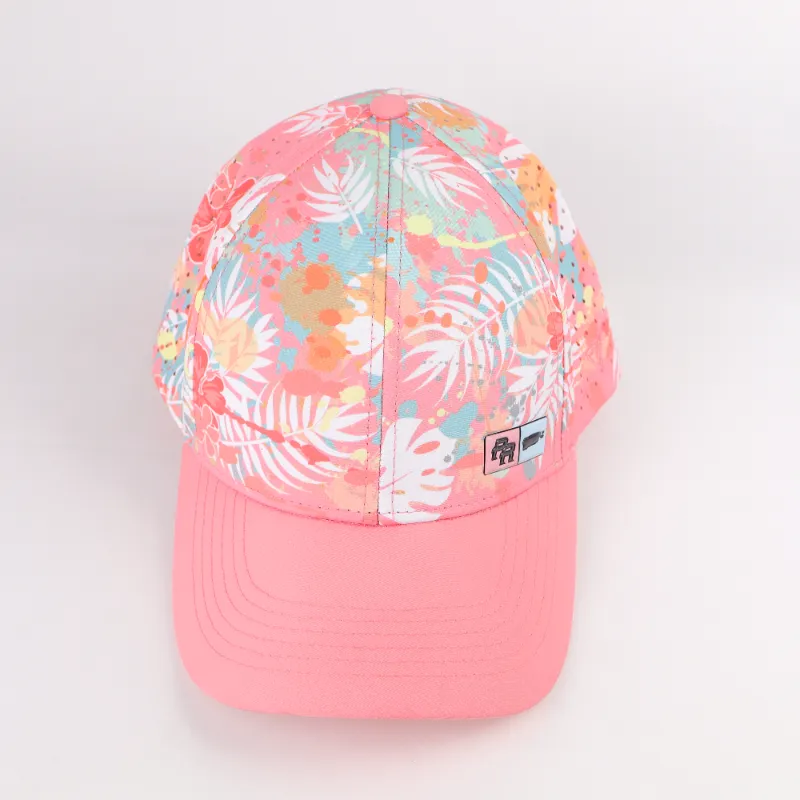
Here is the exact process we used in our Baoding factory to make this batch, and why material selection is 90% of the battle.
1. Material Selection: The Real "Waterproof" Solution
Many people think "waterproof" means putting a plastic coating on cotton. That feels stiff, doesn't breathe, and cracks when you bend the brim. For this cap, we used a high-density polyester blend with a PU (polyurethane) backing.
Why? Because PU lamination gives you a DWR (Durable Water Repellent) finish that makes rain bead up and roll off, without blocking airflow. When we sew the panels together, we also use a special waterproof seam tape on the inside seams. Without that tape, the needle holes from sewing are your biggest leak points.
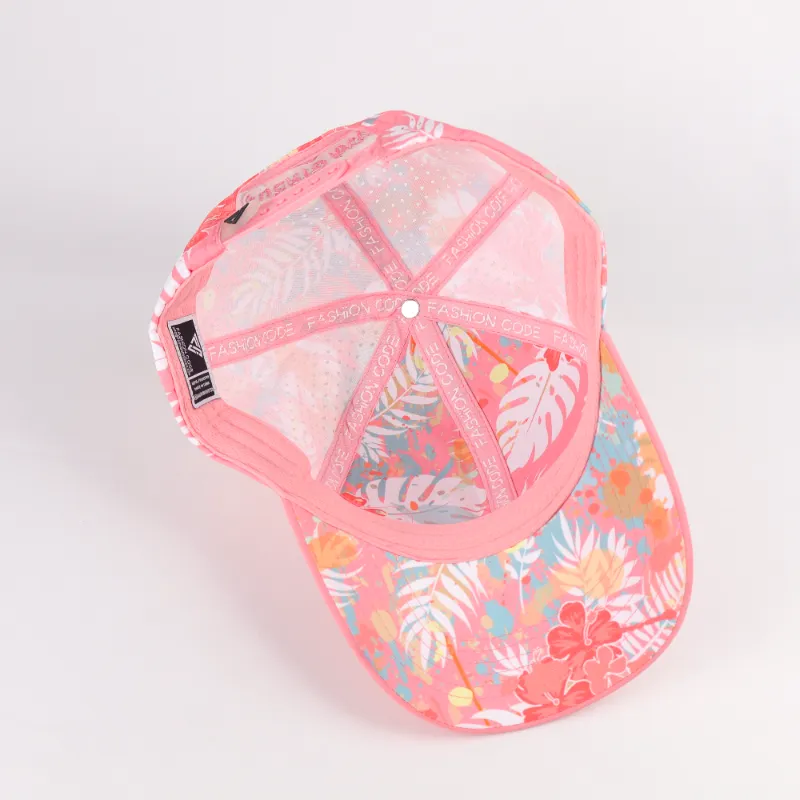
Look at the inside. A cheap hat will hide messy stitching and rough edges inside. For this order, we used a soft double-layer sweatband and reinforced the internal seams with binding tape. This isn't just about comfort — it stops the hat from losing its shape after a few washes.
"The tricky part was the laser perforation. We tested three different hole densities. Too many holes, and the hat loses its structure. Too few, and the customer is sweating. We settled on a 2mm perforation pattern on the side panels and brim."
2. Heat Transfer Printing for Tropical Patterns
You can't achieve this kind of vibrant, gradient coral and teal pattern with standard embroidery. You need all-over sublimation or heat transfer printing.
- Step 1: We print the design onto special transfer paper using eco-friendly sublimation ink.
- Step 2: The paper is pressed onto the pre-cut fabric panels at 200°C for 45 seconds.
- Step 3: The fabric is cooled, then treated with the PU waterproof coating. Do not coat the fabric before printing, or the ink won't bond properly to the fibers.
This is why if a client sends me a photo and says "I want this exact pattern on a waterproof cap," we always need to do a physical sample first. Screens can't show Pantone accuracy, and digital photos lie about color.
3. Laser Perforation: Precision and Heat Management
Our laser cutting machine uses a focused CO2 beam to burn the tiny ventilation holes. The trick here is speed. If the laser moves too slowly, the heat will melt the edge of the PU coating, creating a hard, yellowed rim around each hole. That's a quality fail.
We run the laser at a specific frequency to vaporize the polyester cleanly. After perforation, the caps go through a quality control check where we physically flex the brim. If any coating cracks or flakes off, the batch is rejected.
4. The Sample Approval Gate (Don't Skip This)
I cannot stress this enough. We don't start a 3,000-piece bulk order based on a blurry screenshot. For this pink cap, we made three physical pre-production samples.
- Sample 1: Color was too neon. We adjusted the ink formula.
- Sample 2: The laser holes were too close to the embroidered logo. We shifted the pattern layout.
- Sample 3: Approved. The client wore it in the Florida sun for a week and confirmed it felt cool.
Once you approve that final sample, it becomes the "golden reference" for our sewing and QC teams. We keep it on the shelf next to the bulk production line. Every 100th cap in the bulk run is measured against it.
Ready to Start Your Custom Program?
If you have a design, a tech pack, or even just a rough idea for a custom hat program, send us your brief. We'll tell you exactly what's possible with your budget, material and timeline.
Have a Cap Design or Reference Sample?
Send your design files or your reference sample. We will help you define the next development step and give you a factory-direct quotation.
Chat with our team on WhatsApp